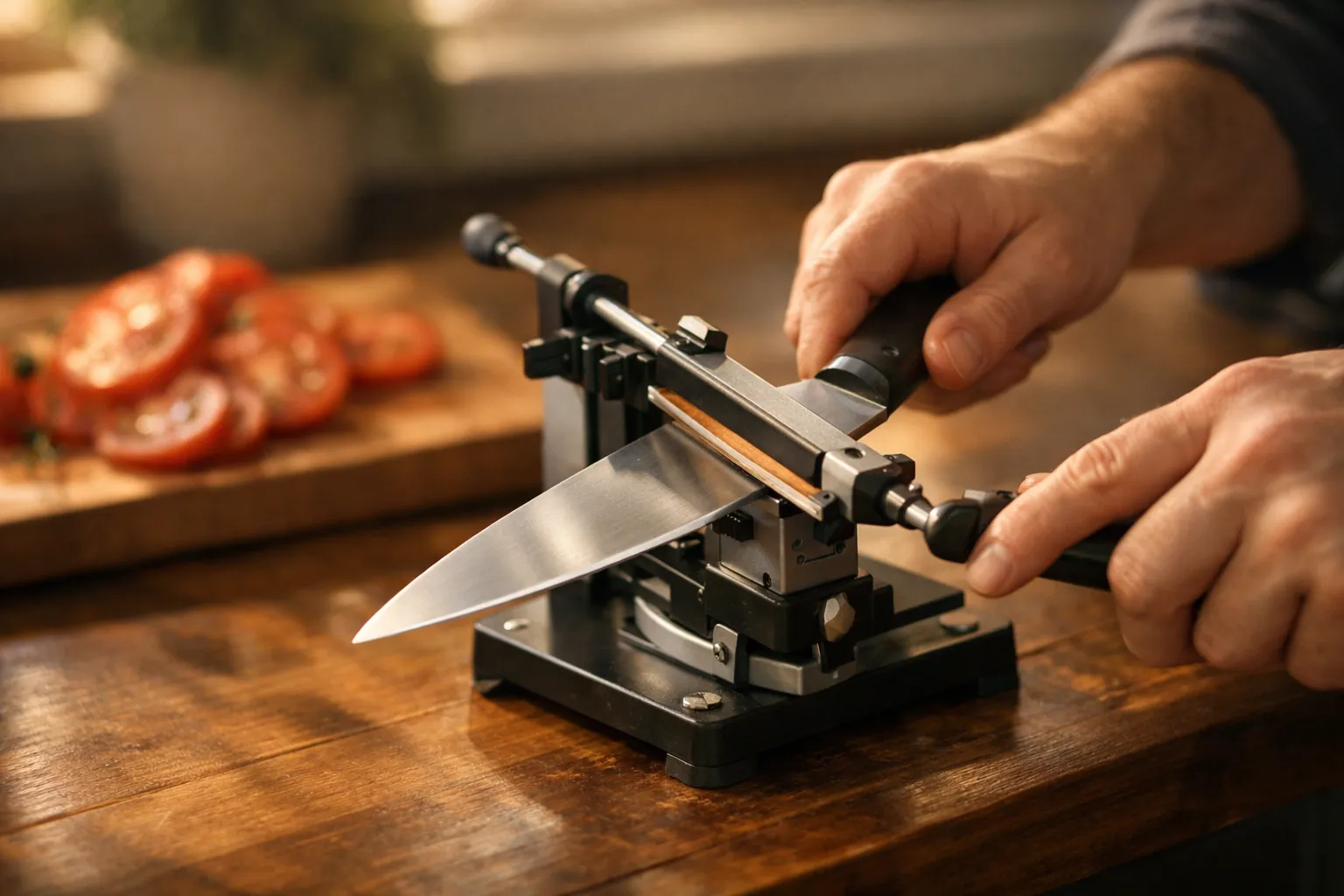
For most beginners, the best knife sharpener is a guided system like the Work Sharp Precision Adjust: it clamps the knife and holds the angle, so your first edge comes out sharp. If you'd rather learn freehand, a 1000/6000 whetstone with an angle guide is the classic starter kit. And if you just want sharp knives with no learning at all, an electric sharpener does it in a minute.
Quick picks
| Best overall for beginners | Work Sharp Precision Adjust | Amazon |
|---|---|---|
| Best whetstone to learn on | Sharp Pebble 1000/6000 Whetstone | Amazon |
| Easiest: zero learning curve | Chef'sChoice 15XV EdgeSelect | Amazon |
| Best budget pick | KitchenIQ Edge Grip 2-Stage | Amazon |
| Best for pocket and hunting knives | Work Sharp Guided Field Sharpener | Amazon |
| Best rolling sharpener | HORL 3 Cruise rolling sharpener | Amazon |
How we picked these sharpeners
We looked at every popular knife sharpener on Amazon's US store and narrowed the list using evidence you can check:
- What people actually buy. Amazon's "bought in the past month" counts as of October 3, 2026. The Sharp Pebble 1000/6000 stone showed 3,000+ purchases in the past month, the Work Sharp Guided Field Sharpener and Chef'sChoice 15XV 2,000+ each, and the KitchenIQ Edge Grip 1,000+.
- Long-term owner ratings. We favored sharpeners with thousands of ratings. The KitchenIQ has more than 97,000; the Sharp Pebble stone more than 25,000.
- Verified specs only. Angles, grits and included parts below come from each manufacturer's Amazon listing, checked October 3, 2026.
- Beginner fit. How the tool controls the sharpening angle, how forgiving it is, and whether you can grow into it.
We research rather than run a sharpening lab: picks come from listings, manuals, owner feedback and well-established sharpening practice. We say so on every page. How we research.
Three questions that pick your sharpener for you
Every sharpener is a trade between effort and control. Answer these three and the choice is mostly made:
- What knives do you have? Cheap stamped kitchen knives forgive anything. Thin, hard Japanese blades chip in coarse pull-through slots and deserve a stone or guided system. Pocket and hunting knives need a tool that handles short, curved blades.
- How much effort will you put in? Ten seconds, ten minutes, or an afternoon learning a skill.
- What do you want to spend? Usable sharpeners start around the price of a takeout lunch; guided systems and good electrics cost more.
| If you… | Get this type | Our pick |
|---|---|---|
| Want sharp kitchen knives with zero learning | Electric | Chef'sChoice 15XV |
| Want the cheapest thing that works | Pull-through | KitchenIQ Edge Grip |
| Own kitchen and pocket knives and want precise edges | Guided system | Work Sharp Precision Adjust |
| Want to learn the real skill | Whetstone | Sharp Pebble 1000/6000 |
| Mostly sharpen pocket and hunting knives | Field sharpener | Work Sharp Guided Field |
The 6 best knife sharpeners for beginners
Work Sharp Precision Adjust
The Precision Adjust removes the hardest part of sharpening: holding a steady angle. You clamp the knife, dial in an angle anywhere from 15 to 30 degrees, and sweep a triangular abrasive along the edge on a slide rod. Because the angle is set by the machine, every stroke hits the same bevel, which is exactly what a beginner can't do by hand.
The three-sided Tri-Brasive gives you 320 and 600 grit diamond plus a fine ceramic, enough to bring back a dull knife and refine the edge. It handles kitchen, pocket, fillet and hunting knives, and it needs no power. With more than 11,000 ratings, it's one of the most-owned guided systems on Amazon.
- Typeclamp-and-arm guided system
- Angleadjustable 15° to 30°
- AbrasivesTri-Brasive 320 & 600 diamond + fine ceramic
- Powernone
- Warranty3 years
Why it stands out
- Sets the angle for you, so the first edge comes out right
- One tool for kitchen and pocket knives
- Quiet and cordless, stores in a drawer
Think twice if
- You want speed: clamping and sweeping takes several minutes per knife
- You sharpen long chef's knives often, since independent reviewers have measured the angle drifting a few degrees near the ends of long blades
Sharp Pebble 1000/6000 Whetstone
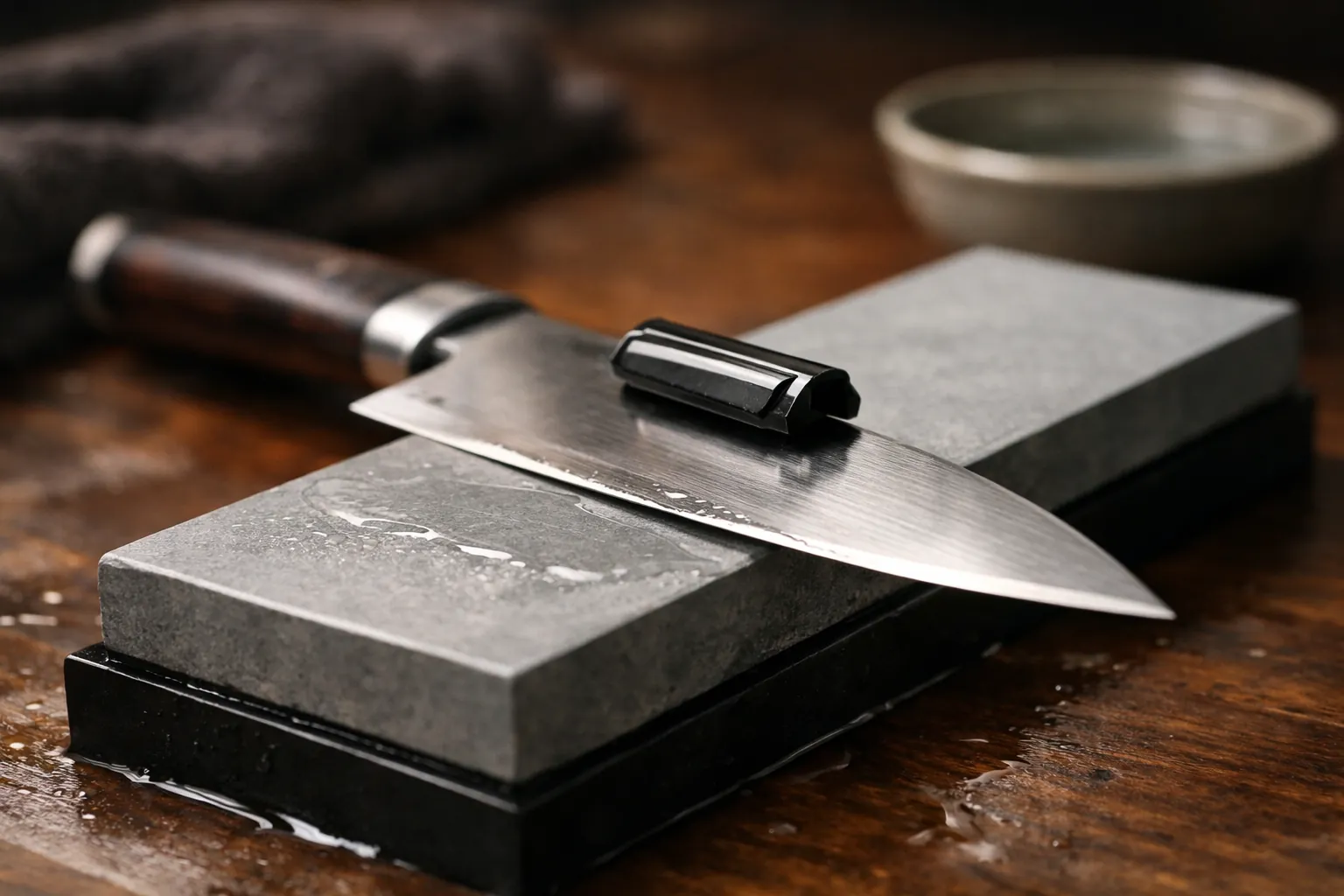
If you want to learn proper sharpening, this is the kit most people start with, and Amazon ranks it #1 in honing stones. The 1000 side sharpens a dull edge; the 6000 side polishes it. It's a water stone, so there's no oil to buy, and Sharp Pebble includes a non-slip bamboo base and a clip-on angle guide that helps you find a consistent angle while you build muscle memory.
Expect the first few sessions to be slow. That's the trade: a whetstone gives you the most control of any sharpener and works on almost any knife, including Japanese ones. Our step-by-step whetstone guide covers the technique.
- Typedual-grit water stone
- Grits1000 / 6000
- Size7.25 x 2.25 x 1 in
- Includedbamboo base, angle guide
- Lubricantwater
Why it stands out
- The classic beginner grit pair at a low price
- Angle guide and non-slip base included
- 25,000+ owner ratings
Think twice if
- You won't practice: a stone needs a few sessions before edges come out reliably sharp
- Your knives are chipped or very dull, because a coarser stone (around 400 grit) is faster for repairs
Chef'sChoice 15XV EdgeSelect
The 15XV is for people who want sharp kitchen knives and no hobby. Spring-loaded guides hold the knife at the right angle; you just pull it through each stage. Chef'sChoice says the first sharpening takes about a minute and re-sharpening about ten seconds. It converts typical 20-degree factory edges to a 15-degree edge, which cuts more easily.
It's a heavy-duty machine with more than 14,000 ratings and steady sales of 2,000+ a month. Our electric sharpener guide covers cheaper and adjustable alternatives.
- Type3-stage electric
- Edge angle15°
- Abrasives100% diamond (stages 1-2), flexible stropping stage 3
- Knivesstraight and serrated
- First sharpeningabout 1 minute (per maker)
Why it stands out
- Consistent results with no skill
- Handles serrated knives
- Fast enough to use every week
Think twice if
- You own single-bevel Japanese knives (yanagiba, deba), which electric slots aren't made for
- You want to keep a 20-degree edge on heavy-duty knives
- You're on a tight budget
KitchenIQ Edge Grip 2-Stage
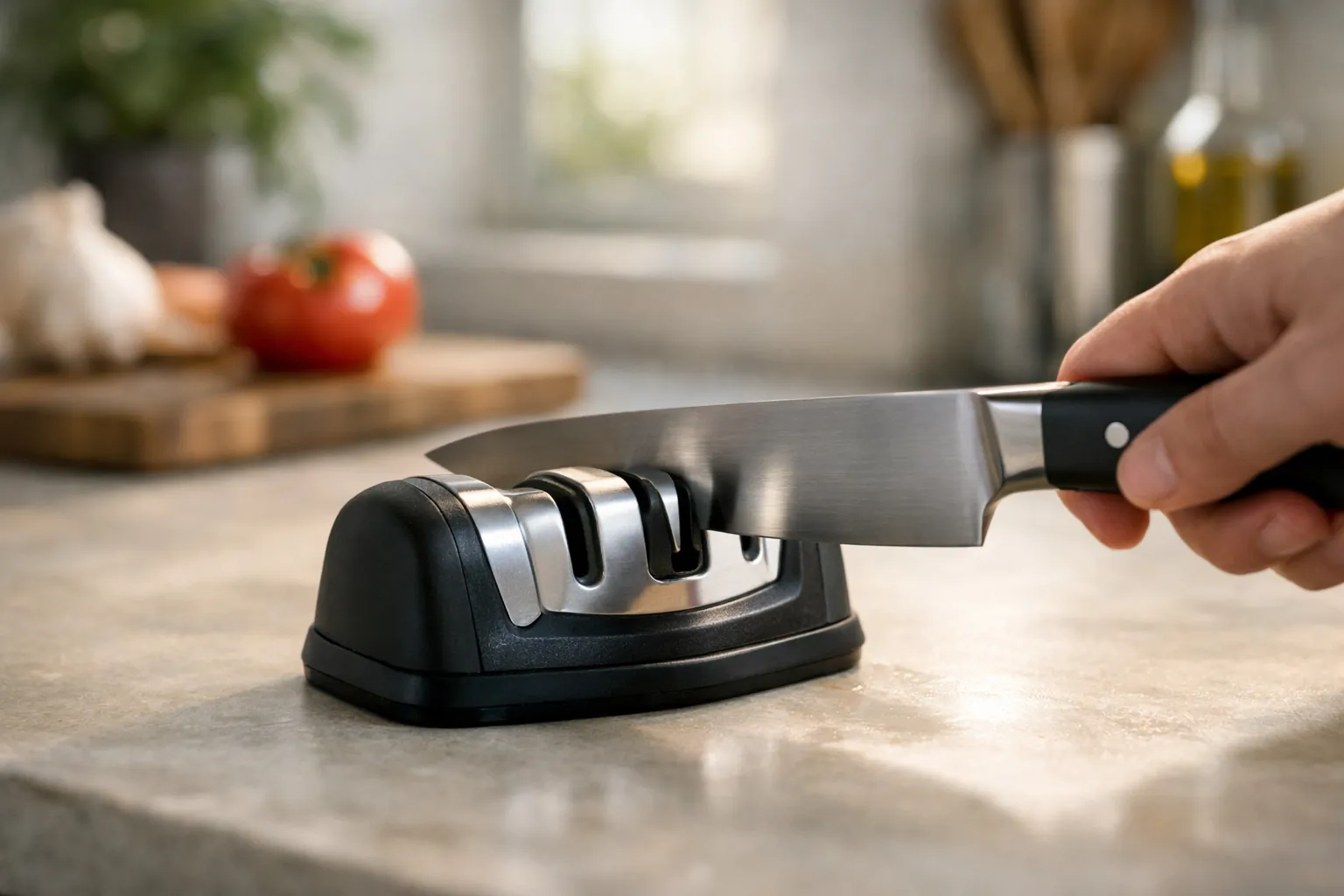
This is one of the best-selling knife sharpeners on Amazon, with nearly 98,000 ratings. A carbide slot restores a dull edge, a ceramic slot touches it up, and a notch in the base hooks over the edge of the counter so a long knife's tip doesn't drag. It costs about as much as a sandwich.
Use the ceramic slot for most touch-ups and save the carbide slot for knives that are truly dull: carbide removes metal fast. It's a sensible pick for inexpensive knife sets, college kitchens and rentals.
- Typemanual pull-through
- Stagescarbide (coarse) + ceramic (fine)
- Knivesstraight and serrated
- Basenon-slip, counter-edge V grip
- Warranty1 year limited
Why it stands out
- Cheap, compact, almost impossible to use wrong
- Ceramic stage for gentle weekly touch-ups
Think twice if
- Your knives are expensive or Japanese: the carbide stage is too aggressive for them
- You want a refined, long-lasting edge
Work Sharp Guided Field Sharpener
If your knives fold or live in a sheath, this is the beginner tool to get. Built-in guides help you hold 20 or 25 degrees, which suits most pocket and outdoor knives. It packs five abrasives into a flat, pocketable body: two diamond plates, a ceramic rod with coarse, fine and fish-hook surfaces, and a leather strop. It's a top-10 seller in Amazon's knife sharpeners with 2,000+ purchases last month.
- Typehandheld guided field sharpener
- Guides20° and 25°
- Abrasivescoarse and fine diamond plates, ceramic rod, leather strop
- Extrasfish hook groove
- Weight135 g
Why it stands out
- Five abrasives in one compact tool
- Angle guides for pocket and hunting knives
- Strop included for a cleaner final edge
Think twice if
- You mainly sharpen kitchen knives at 15 degrees, since the guides are set for 20° and 25°
HORL 3 Cruise rolling sharpener
Rolling sharpeners have become popular because they're simple and pleasant to use: a magnetic block holds the knife at 15 or 20 degrees, and you roll a disc along the edge. The HORL 3 Cruise pairs a diamond disc for sharpening with a steel disc that removes the burr. HORL says the 15-degree side suits fine Japanese and carbon blades and the 20-degree side suits European chef's knives and outdoor knives.
- Typerolling sharpener with magnetic angle support
- Angles15° and 20°
- Discsdiamond + stainless steel honing
- Waternot needed
- Made inGermany
Why it stands out
- Two common angles, no guesswork
- No water, no mess, looks good on a counter
- Works on hard and soft steels
Think twice if
- You need angles other than 15° or 20°
- You want the most value: it costs more than a guided system that does more
Side-by-side comparison
| Sharpener | Type | Angle control | Serrated | Learning curve |
|---|---|---|---|---|
| Work Sharp Precision Adjust | Guided | 15°–30° dial | Listed as supported | Low |
| Sharp Pebble 1000/6000 | Whetstone | Clip-on guide | Not suited | High |
| Chef'sChoice 15XV | Electric | Fixed 15° | Yes | None |
| KitchenIQ Edge Grip | Pull-through | Fixed (preset) | Yes | None |
| Work Sharp Guided Field | Field | 20° / 25° guides | Ceramic rod | Low |
| HORL 3 Cruise | Rolling | 15° / 20° | No (smooth blades) | Low |
What actually matters for a first sharpener
Angle control beats grit count
A sharp edge is two flat bevels meeting cleanly. If your angle wobbles from stroke to stroke, you round the edge off and it never gets sharp, no matter how fine the stone. That's why guided, electric and rolling sharpeners are easier for beginners: they hold the angle for you. Our knife sharpening angle chart lists common angles by knife type.
Match the angle to your knives
Many Western and German kitchen knives are sharpened at around 20 degrees per side; many Japanese knives at around 15 degrees per side; pocket and hunting knives often at 20 to 25 degrees. These are common starting points, not rules, so check your knife maker's recommendation.
Coarse removes, fine refines
Every sharpener has a coarse stage that removes metal and a fine stage that polishes. Beginners tend to overuse the coarse stage. If the knife is only a little dull, start fine. See the grit chart for what each number does.
Sharpening and honing are different jobs
Sharpening removes metal to make a new edge. Honing realigns an edge that has rolled over in use. A honing rod used every week or two means you sharpen far less often. More in honing rod vs whetstone.
Add a honing rod and you'll sharpen less
A honing rod is the cheapest upgrade for any beginner. A few light strokes before cooking straighten the edge, so it stays sharp for weeks between sharpenings. The Utopia Kitchen 12-inch honing rod is a popular, inexpensive carbon-steel rod with a non-slip handle and a hanging loop. Our best honing rod guide compares steel, ceramic and diamond rods.
Ready to step up later?
If you catch the sharpening bug, the Work Sharp Precision Adjust Elite adds 320 and 600 grit diamond plates, a ceramic finishing rod, a dedicated serrated rod and a leather strop to the same 15° to 30° system. For a whetstone path, our whetstone set guide covers multi-stone kits.
The bottom line
For most beginners, the Work Sharp Precision Adjust is the best knife sharpener: it holds the angle so you don't have to, and it handles kitchen and pocket knives. If you want to learn freehand, start with the Sharp Pebble 1000/6000 whetstone. If you want no learning at all, get the Chef'sChoice 15XV, and if budget is everything, the KitchenIQ Edge Grip will do the job on everyday knives.
Specs, ratings and sales figures come from each product's Amazon listing, checked October 3, 2026. We do not quote prices we have not checked; the buttons show the current price on Amazon. How we research · Affiliate disclosure