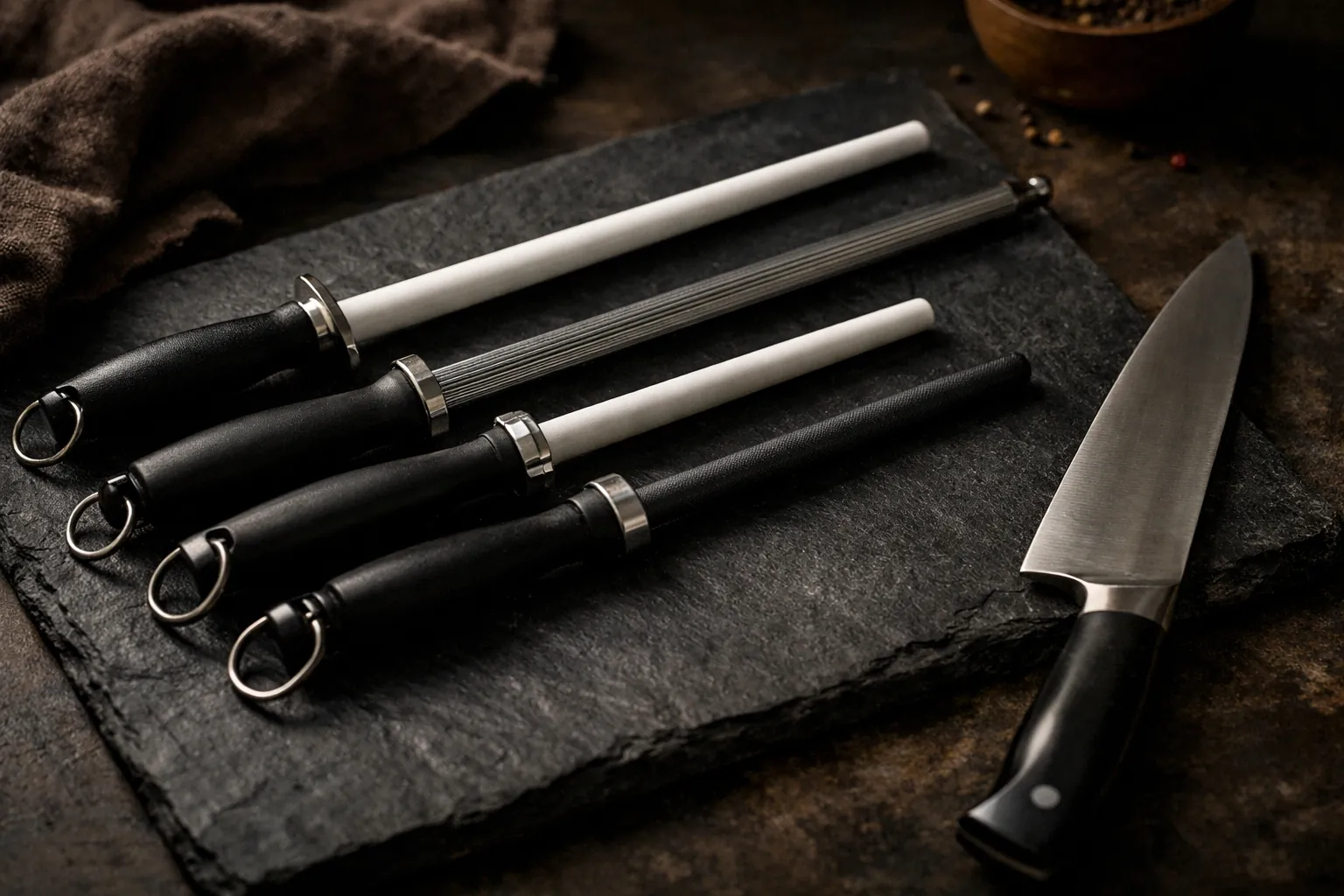
Get a fine ceramic rod, and the Messermeister 12-inch (1200 grit) is the one we'd buy. It keeps German and Japanese knives in line and takes off a whisker of steel while it does. A kitchen with only German knives can use a classic steel such as the Wüsthof 9-inch instead. Diamond rods are sharpeners in disguise, so leave them for the occasional quick fix.
Quick picks
| Best overall | Messermeister 12" Ceramic Sharpening Rod | Amazon |
|---|---|---|
| Best steel for German knives | Wüsthof 9" Honing Steel | Amazon |
| Best for beginners | Work Sharp Kitchen Ceramic Honing Rod | Amazon |
| Best value ceramic | SHARPAL 118N Ceramic Honing Rod | Amazon |
| Best compact rod for Japanese knives | Mac Ceramic Honing Rod 8.5" | Amazon |
| Best budget steel | Utopia Kitchen 12" Honing Rod | Amazon |
| Best diamond rod | Kota Japan 12" Diamond Sharpening Rod | Amazon |
How we picked
Sales numbers come from Amazon search results on October 3, 2026. The Kota Japan diamond rod led with 1,000+ purchases last month. The Henckels steel and the SHARPAL 118N ceramic showed 600+ each, and the Wüsthof steel 400+ with 3,300+ ratings.
Then we sorted by material, because that matters more than brand. Steel goes with softer Western knives. Ceramic goes with Japanese knives or a mixed set. Diamond only makes the list as a fast sharpener. Specs are from each product's Amazon listing, and where a listing leaves something out we say "check listing."
We haven't had these rods in hand. The picks rest on the listings and on what owners report, checked against standard knife-care practice. How we research.
Steel vs ceramic vs diamond
| Material | What it does | Pros | Cons |
|---|---|---|---|
| Steel | Pushes a rolled edge back into line | Unbreakable, traditional, fast | Little effect on hard steel; ridged versions can be harsh |
| Ceramic | Straightens and lightly abrades | Works on almost any knife; refines the edge | Can chip or break if dropped; needs cleaning |
| Diamond | Removes metal quickly | Brings back a dull knife fast | Too aggressive for daily use |
The 7 best honing rods
Messermeister 12" Ceramic Sharpening Rod
One rod for every knife in a home kitchen: that's the case for a long, fine ceramic, and this is a well-rated one at 4.6 stars from 1,100+ ratings. At 1200 grit it realigns and refines the edge without the bite of a coarse rod. Japanese knives are safe on it and German knives still respond. Twelve inches leaves room for long chef's and slicing knives.
- Materialsolid ceramic core, break-resistant (per listing)
- Gritfine 1200
- Length12 in
- Handleergonomic, with hang ring
Why it stands out
- Works on soft and hard steels
- Long enough for 10-inch chef's knives
Think twice if
- You drop things often: ceramic can break
Wüsthof 9" Honing Steel
German knives, German steel. Wüsthof forges this grooved 9-inch rod from high-carbon stainless tempered to 58 HRC, and it's magnetic, so loose metal particles stick to the rod. Owners give it 4.7 stars across 3,300+ ratings. The one catch is length: nine inches suits knives up to about 8 inches, so buy longer if your chef's knife is bigger.
- Materialhigh-carbon stainless steel, 58 HRC
- Length9 in
- Surfacegrooved, magnetic
- Ratings3,300+ at 4.7 stars
Why it stands out
- Unbreakable, traditional
- Ideal for softer Western steels
Think twice if
- You own Japanese knives
- Your chef's knife is longer than about 8 inches
Work Sharp Kitchen Ceramic Honing Rod
Holding the right angle is the hard part of honing, and this rod does it for you. Built-in angle guides set the blade the same way on every stroke. A rubber tip keeps it planted on the cutting board. Work Sharp lists it for chef's knives and santokus as well as paring and serrated knives. If you've never honed, start here.
- Materialfine ceramic
- Anglebuilt-in angle guides
- Tiprubber, for stable honing on a board
- Kniveschef, santoku, paring, serrated
Why it stands out
- Angle guidance for beginners
- Listed for serrated knives
Think twice if
- You already hone confidently freehand
SHARPAL 118N Ceramic Honing Rod
Ceramic's weak spot is the tip. Knock it on the counter and it chips. SHARPAL's answer is an anti-breaking cap, on a rod that costs less than the Messermeister and sold 600+ last month.
- Materialceramic, fine
- Extrasanti-breaking cap (per listing title)
- Lengthcheck listing
Why it stands out
- Fine ceramic for mixed knife sets
- Protective cap
Think twice if
- You need a 12-inch rod for long knives: check the listing length
Mac Ceramic Honing Rod 8.5"
From a Japanese knife maker, made in Japan, and sized for santokus and petty knives. Mac describes it as a hone, not a sharpener. At 8.5 inches it works for blades up to about 7 inches; anything longer runs off the end.
- Materialceramic
- Length8.5 in
- Made inJapan
- Carehand wash
Why it stands out
- Ceramic for hard Japanese steel
- Compact for small kitchens
Think twice if
- Your knives are longer than about 7 inches
Utopia Kitchen 12" Honing Rod
Western knives and very little to spend? Utopia's rod is carbon steel plated with nickel-chrome, with a non-slip handle and a loop for hanging. It has 8,300+ ratings, and at twelve inches it's long enough for any home chef's knife.
- Materialcarbon steel, nickel-chrome plated
- Length12 in
- Handleergonomic, non-slip
- Extrashanging loop
Why it stands out
- Very low cost
- Long enough for big knives
Think twice if
- You own Japanese knives
Kota Japan 12" Diamond Sharpening Rod
Strictly speaking this is a sharpener shaped like a rod. Diamond cuts steel, so use it to bring a dull Western knife back between proper sharpenings, with very light pressure and only a few strokes. Of everything here it sells best: 1,000+ purchases last month and 7,800+ ratings.
- Materialdiamond electroplated carbon steel
- Length12 in
- Shapeoval
- Guaranteelifetime (per listing)
Why it stands out
- Restores a dull edge fast
- Long, inexpensive
Think twice if
- You want a daily hone
- You own Japanese knives
Side-by-side comparison
| Rod | Material | Length | Best for |
|---|---|---|---|
| Messermeister 12" ceramic | Ceramic (1200) | 12 in | Most kitchens |
| Wüsthof 9" steel | Steel | 9 in | German knives |
| Work Sharp ceramic | Ceramic, angle-guided | Check listing | Beginners |
| SHARPAL 118N | Ceramic | Check listing | Value |
| Mac 8.5" ceramic | Ceramic | 8.5 in | Short Japanese knives |
| Utopia 12" steel | Steel | 12 in | Budget |
| Kota Japan diamond | Diamond | 12 in | Quick sharpening |
Buying guide
Length
Pick a rod at least as long as your longest blade, ideally a little longer, so the whole edge travels along it in one stroke.
Angle and pressure
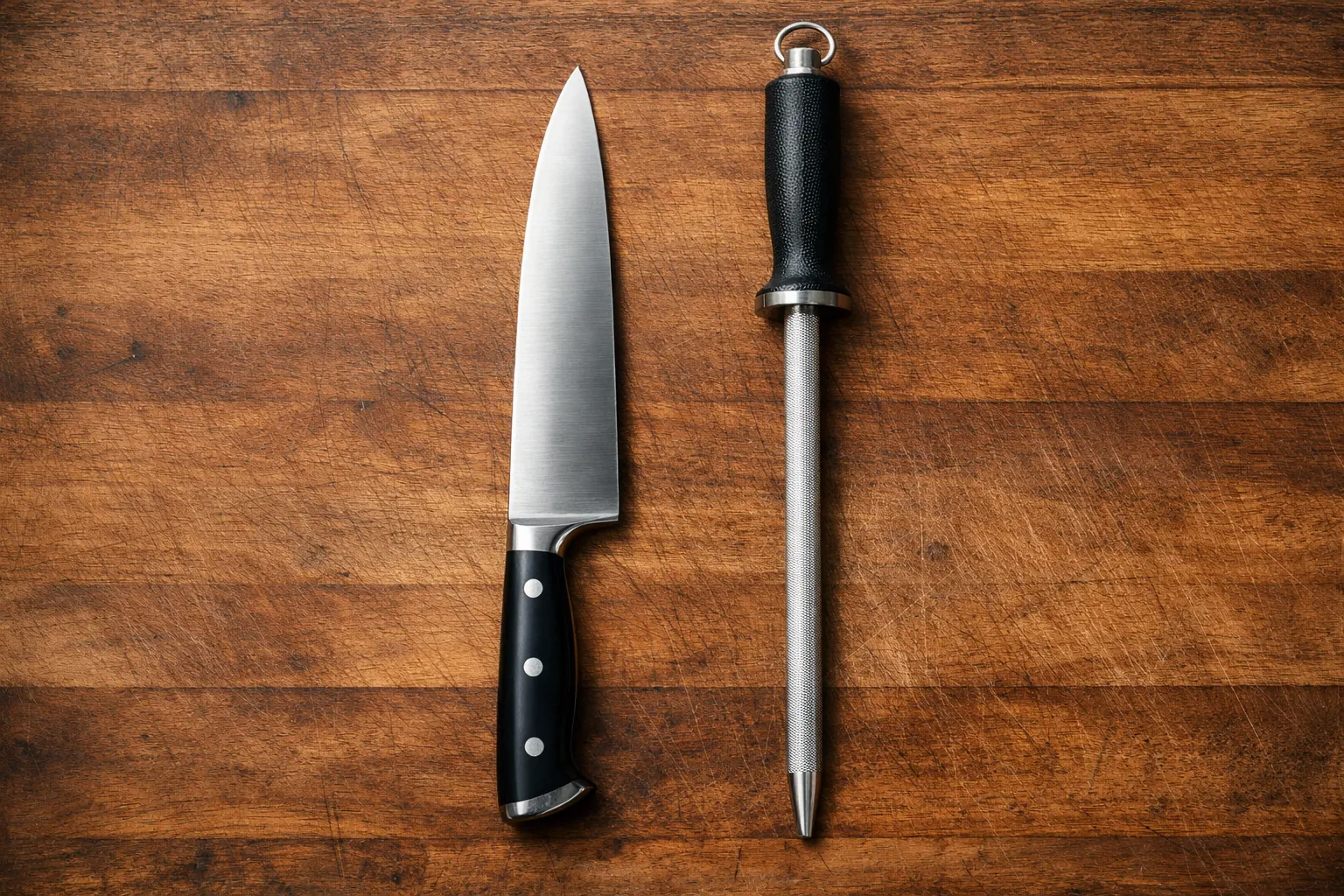
Hone at about your knife's sharpening angle (many Japanese knives around 15° per side, many German knives around 20°; check your knife maker's recommendation) with very light pressure. Our honing guide shows the technique.
Ridged vs smooth steel
Ridged steels bite more and can be rough on an edge. Smooth or fine steels are gentler. Choose fine.
Care
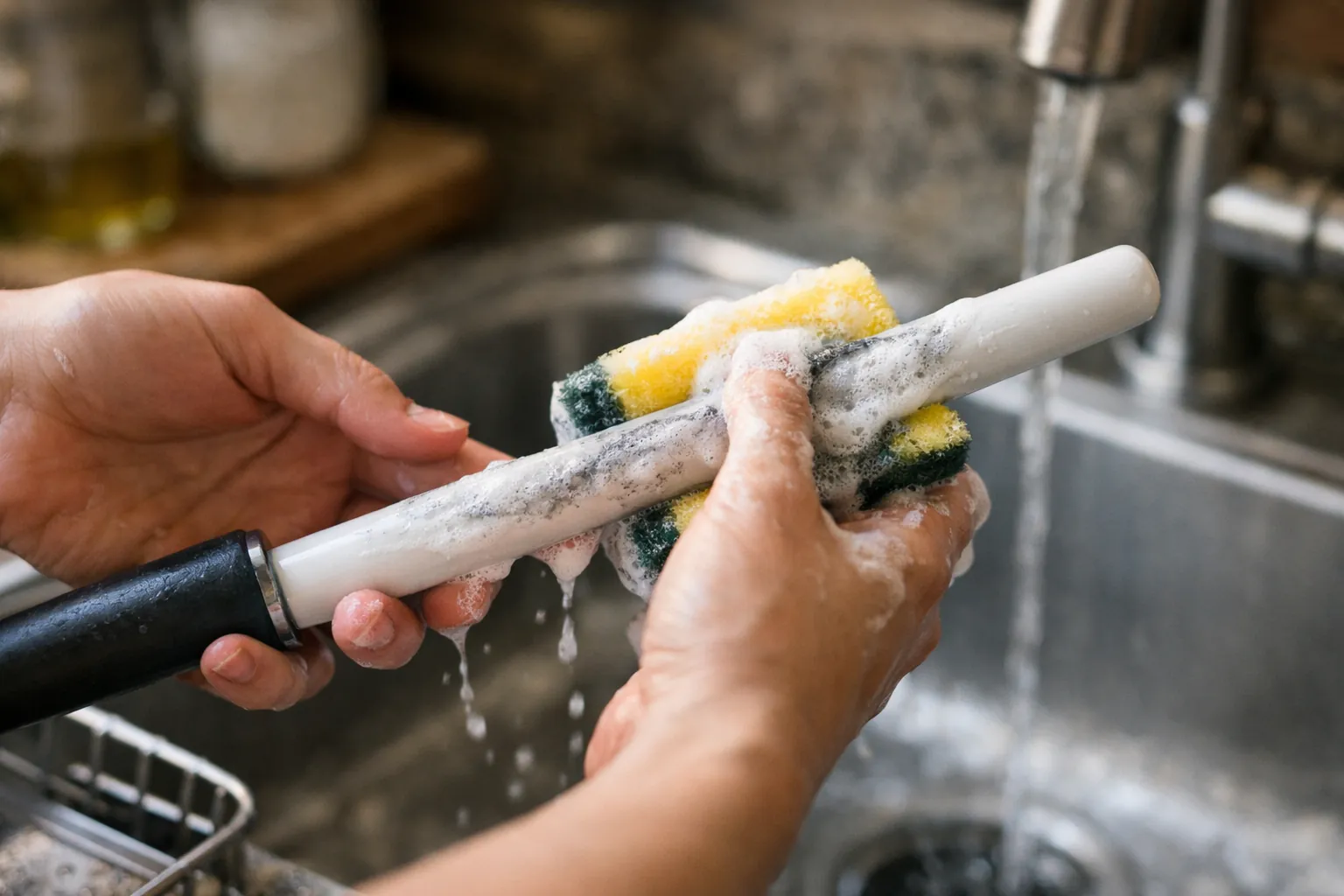
Wipe steel rods dry. Clean ceramic rods with a mildly abrasive cleanser to remove the gray steel marks, and store them where they won't be knocked off the counter.
How to hone in five steps
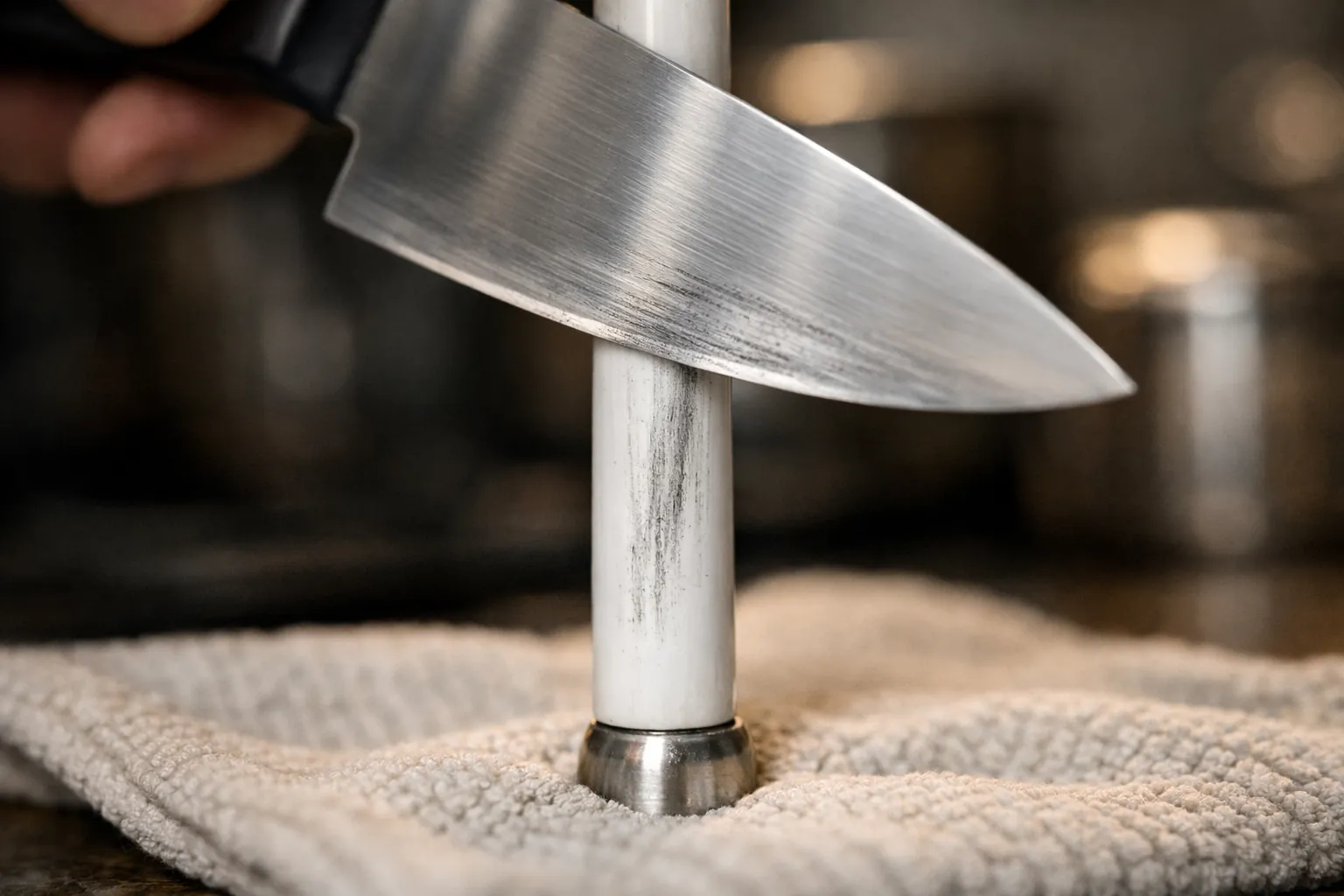
- Stand the rod upright with its tip on a folded towel so it can't slip.
- Place the heel of the blade near the top of the rod at roughly your sharpening angle.
- Draw the knife down and back so the whole edge, heel to tip, passes along the rod.
- Alternate sides for five or six strokes each, with about the weight of the knife as pressure.
- Finish with one or two feather-light strokes per side, then wipe the blade.
Hone before cooking, or whenever the knife starts slipping on tomato skins. If a dozen strokes don't bring it back, the edge is worn and needs sharpening.
Common honing mistakes
The most common one is holding the blade too far off the rod. A steep angle rounds the edge instead of straightening it, so stay close to the sharpening angle. Pressure is the next problem: pushing hard can roll a soft edge further or chip a hard one.
- Stopping short of the tip. Finish every stroke with the tip on the rod.
- Reaching for the diamond rod every day. It wears the knife down.
- Ignoring a gray, glazed ceramic rod. It stops cutting until you clean it.
Alternatives to a rod
For very hard Japanese edges, a leather strop is gentler still. When honing stops bringing the edge back, the knife needs sharpening; see the best sharpeners for kitchen knives.
If you only buy one rod
Make it the Messermeister 12" ceramic rod. It's the rod we'd hand to someone without asking what knives they own. A drawer of nothing but German knives is the exception, and the Wüsthof 9" steel suits it better. A first-time honer will find the angle sooner with the Work Sharp angle-guided ceramic rod, and the Utopia 12" steel does the job for Western knives when money is tight. Use it before you cook, while the edge is still good, not after the knife has gone dull.
Ratings and sales come from Amazon, along with the listing details, checked October 3, 2026. We do not quote prices we have not checked. How we research · Affiliate disclosure