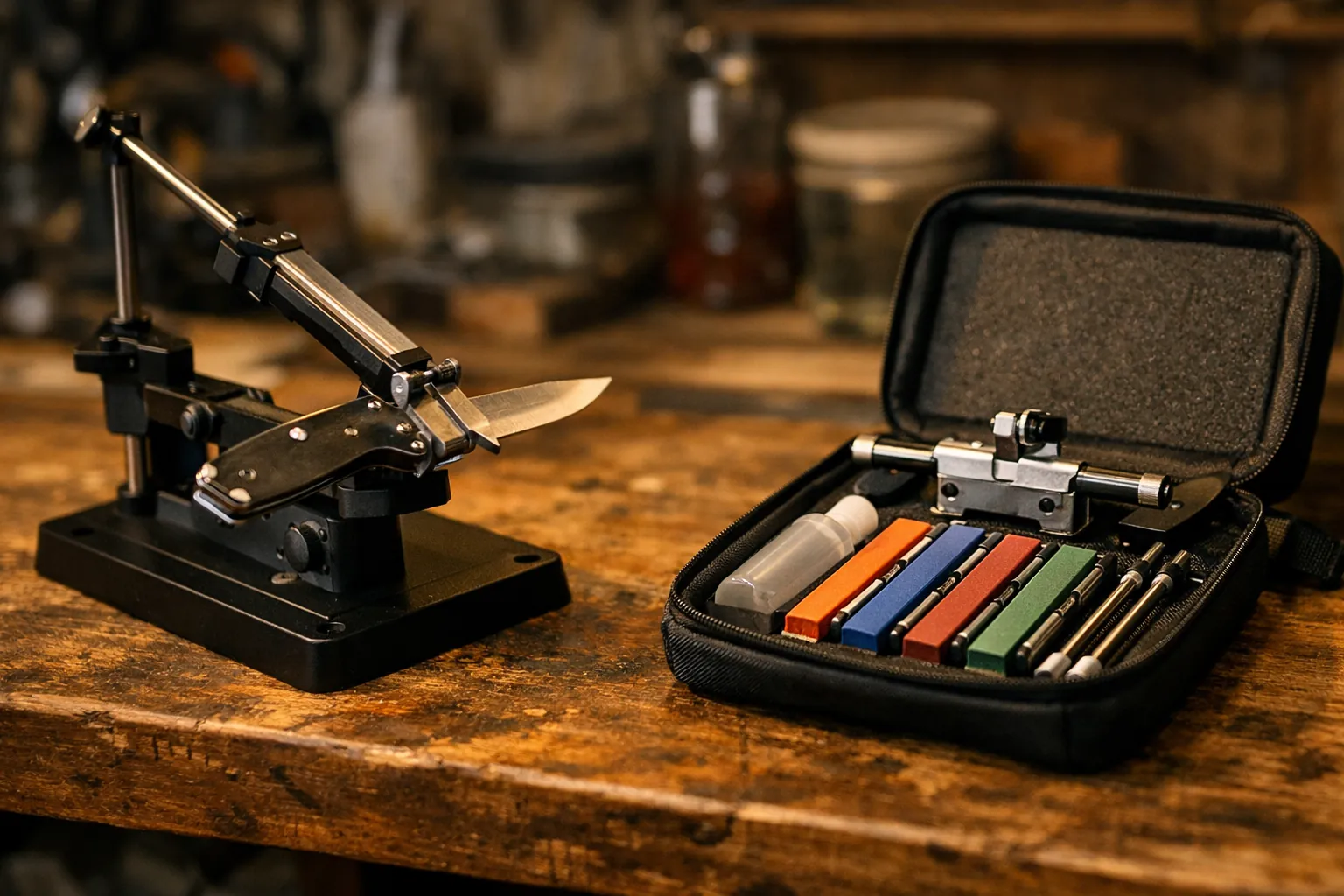
Buy the Work Sharp Precision Adjust if you want the easiest guided sharpener with any angle from 15° to 30°; buy a Lansky kit if you want more grits for less money and a system small enough to take camping. Both clamp the blade so the angle stays consistent. The Work Sharp is faster to set up and needs no oil; the Lansky asks for a bit more technique but rewards it with a wider grit range.
Quick picks
| Easiest guided system | Work Sharp Precision Adjust | Amazon |
|---|---|---|
| Best Work Sharp upgrade | Work Sharp Precision Adjust Elite | Amazon |
| Best value guided kit | Lansky Deluxe 5-Stone System | Amazon |
How we compared them
We compared the current Amazon listings for every Work Sharp Precision Adjust and Lansky controlled-angle kit on October 3, 2026, plus owner ratings and recent sales:
- Work Sharp Precision Adjust: 11,500+ ratings and 1,000+ bought in the past month; the Elite version also 1,000+.
- Lansky Deluxe 5-stone: 14,000+ ratings and 300+ bought in the past month.
- Specs, grits and included parts below come from the listings. Lansky's preset clamp angles (17°, 20°, 25°, 30°) are from Lansky's published system design.
This is a spec and evidence comparison; we didn't run a sharpening test. How we research.
The key difference: what moves
| Work Sharp Precision Adjust | Lansky Deluxe 5-stone | |
|---|---|---|
| Angle range | 15°–30°, adjustable | 17°, 20°, 25°, 30° preset holes |
| Abrasives | Tri-Brasive: 320 and 600 diamond, fine ceramic | Five hones: 70, 120, 280, 600, 1000 (Lansky's scale) |
| Lubricant | None | Honing oil (included) |
| Setup | Benchtop base | Hand-held, or on an optional mount |
| Portability | Folds for storage | Small carry case |
| Serrated | Listed as supported; Elite adds a serrated rod | Serrated hone in the Professional kit |
| Warranty (listing) | 3 years | 1 year |
| Amazon ratings | 11,500+ | 14,000+ |
Work Sharp Precision Adjust: the easier one
Work Sharp Precision Adjust
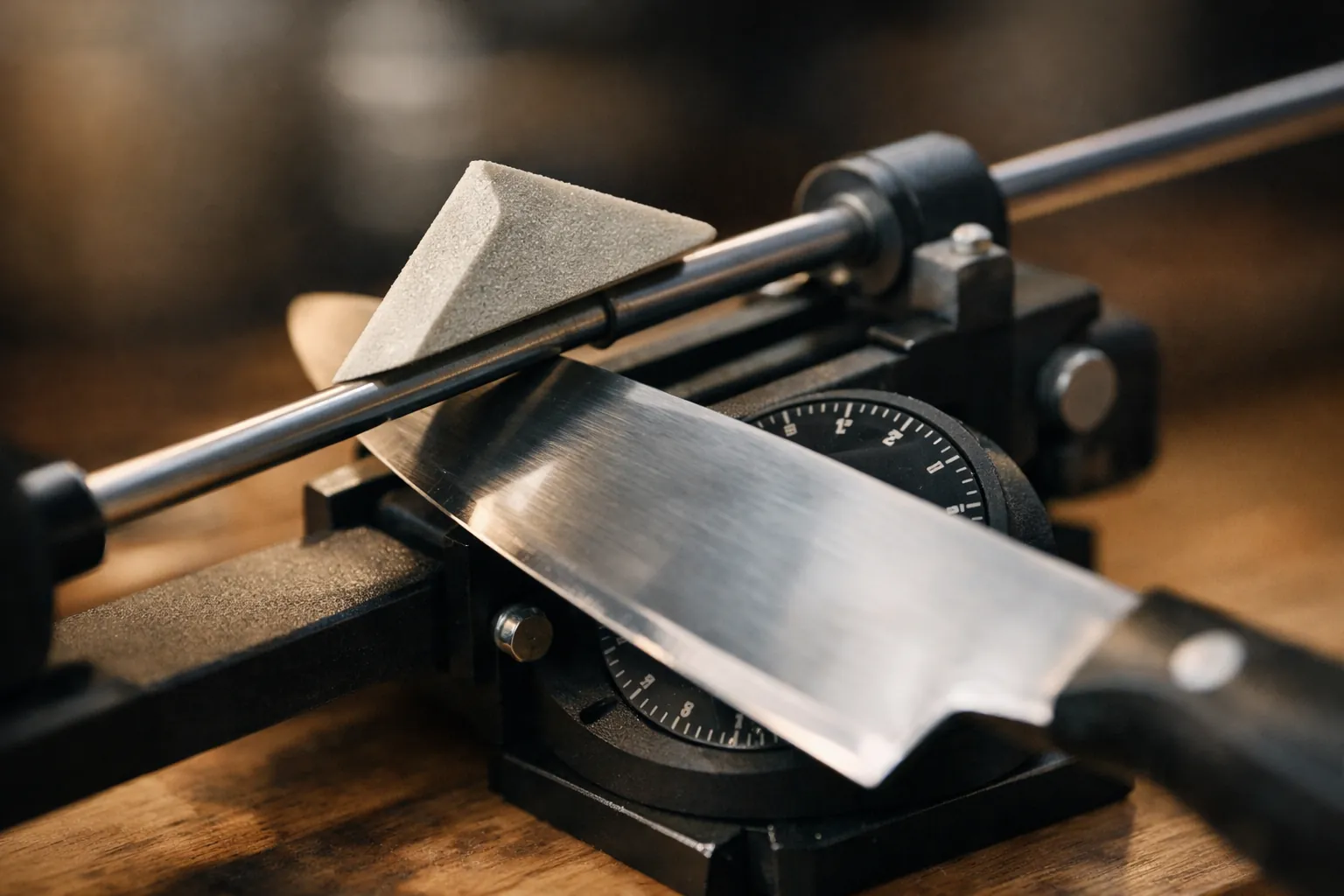
The Precision Adjust sits on a benchtop base, clamps the knife, and lets you dial in any angle from 15° to 30°. A three-sided abrasive on a slide rod sweeps across the edge, and you rotate it from 320 diamond to 600 diamond to fine ceramic as you go. There's no oil, no hand-held clamp to balance and very little to learn.
The trade-offs: three abrasives is a narrower range than Lansky's five, and independent reviewers have measured the angle drifting a few degrees toward the ends of long blades, a common issue with pivoting-arm designs.
- Angle15° to 30°
- AbrasivesTri-Brasive 320 & 600 diamond, fine ceramic
- Powernone
- Includedbenchtop base, knife clamp, slide rod
- Warranty3 years
Why it stands out
- Fastest setup and easiest to use
- Any angle from 15° to 30°
- Dry abrasives, no mess
Think twice if
- You want very coarse grits for reprofiling or a very fine polish
- You need to pack it into the field
Work Sharp Precision Adjust Elite
The Elite keeps the same angle system and adds separate coarse and fine diamond plates, a ceramic finishing rod, a conical ceramic rod for serrated knives and a leather strop. It's the version to buy if you have serrated knives or want a stropped finish without buying extras.
- Angle15° to 30°
- Abrasives320 diamond plate, 600 diamond plate, ceramic finishing rod, serrated rod, Tri-Brasive
- Extrasleather strop
- Length14.5 in (listing)
Why it stands out
- Dedicated serrated rod and leather strop
- Separate plates for coarse and fine work
Think twice if
- You only sharpen plain-edge knives occasionally
At the top of the range, the Work Sharp Professional Precision Adjust adds metal construction, a digital angle indicator (15° to 30°) and seven abrasives: 220, 320, 400, 600 and 800 diamond, fine ceramic and a leather strop.
Lansky: more grits for less
Lansky Deluxe 5-Stone System
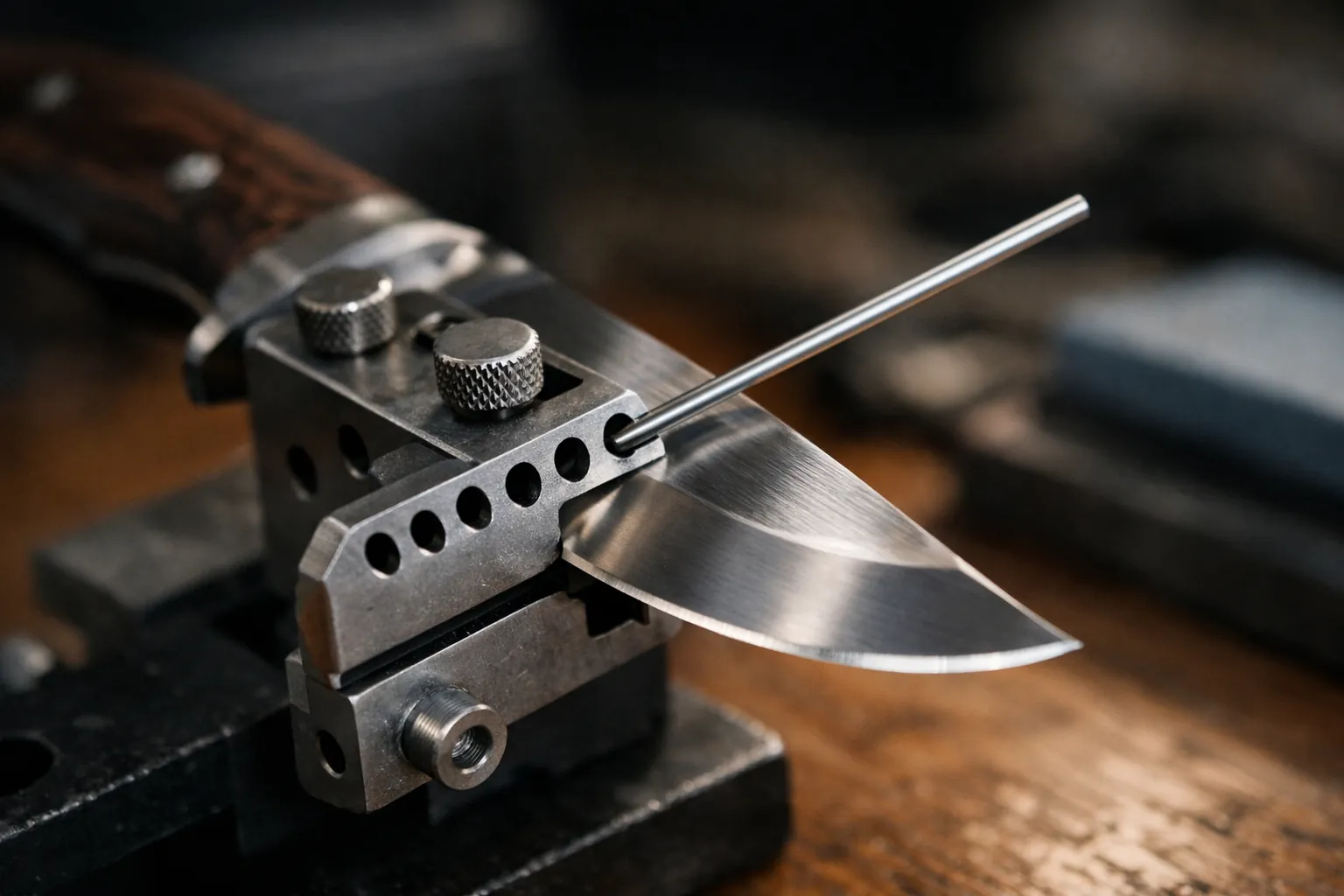
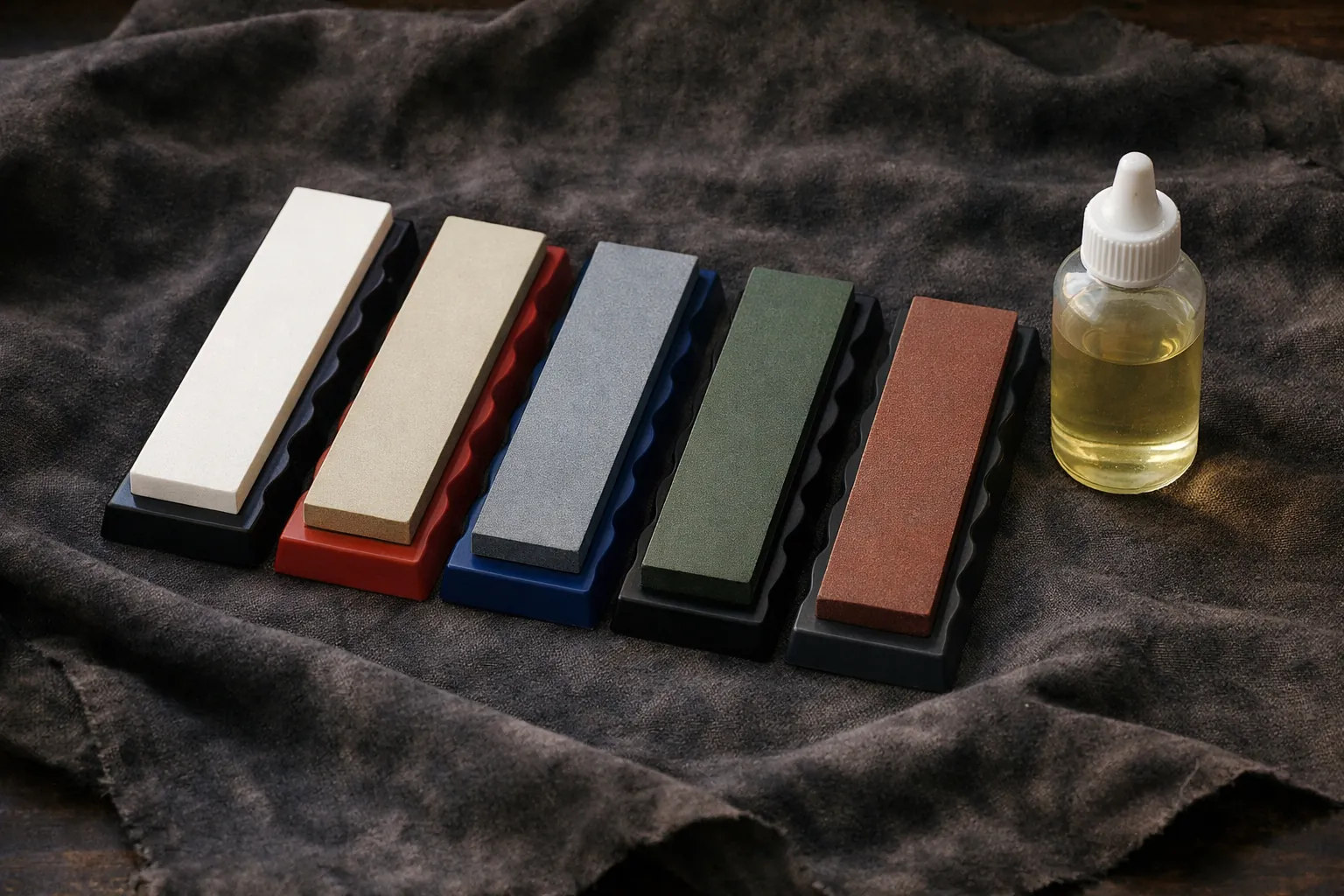
Lansky's system has been around for decades and it's still one of the best-value ways to get a consistent edge. You clamp the blade, push each hone's guide rod into one of four angle holes, and stroke the hone across the edge. The Deluxe kit runs from a 70-grit extra-coarse hone, useful for reprofiling or repairing chips, to a 1000-grit ultra-fine ceramic for finishing.
It takes more coordination than the Work Sharp: you hold the clamp in one hand and the hone in the other (or buy Lansky's optional mount), and the hones use oil. Owners also note some play in the clamp holes, which can make the angle slightly less precise than the numbers suggest.
- Angles17°, 20°, 25°, 30° preset
- Honesextra coarse (70), coarse (120), medium (280), fine (600), ultra fine (1000)
- Materialalumina oxide and ceramic
- Includedclamp, guide rods, honing oil, case
- Warranty1 year (listing)
Why it stands out
- Five grits from extra coarse to ultra fine
- Compact case for camping and hunting trips
- 14,000+ ratings
Think twice if
- You want an adjustable angle between the presets
- You dislike oily cleanup
- You find it awkward to hold a clamp and stroke at the same time
Which Lansky kit?
| Kit | Hones (listing) | Best for |
|---|---|---|
| Standard 3-stone | Coarse 120, medium 280, fine 600 | Lowest cost entry |
| Deluxe 5-stone | 70, 120, 280, 600, 1000 | Most people |
| Professional | 120, 280, 600, 1000, plus serrated medium | Serrated knives |
| Deluxe Diamond 4-stone | Diamond 100, 200, 400, 600; lifetime warranty listed | Very hard steels, faster cutting |
Which is better for your knives?
Kitchen knives
Long chef's knives are where the differences show. Both systems clamp the blade near its middle, so the angle changes slightly toward the heel and tip of a long blade. The Work Sharp's base keeps the knife steady and the motion simple, which most home cooks will find easier. The Lansky's lowest preset is 17°, so if your Japanese knife maker recommends around 15° per side, the Work Sharp gets closer. For a whole block of kitchen knives, consider an electric instead; see the best sharpeners for kitchen knives.
Pocket and EDC knives
Both are good here, because short blades sit almost entirely within the clamp's sweet spot. The Lansky's five grits make it easy to reset a factory edge to your own angle, and its case is small enough for a backpack. The Work Sharp is faster for regular touch-ups at a bench. See our pocket knife sharpener picks.
Hunting and outdoor knives
Thicker blades sharpened at 20° to 25° per side suit either system. If you want to sharpen at camp, the Lansky wins on portability. If you'll sharpen at home after the trip, the Work Sharp is quicker.
Learning curve and technique
With the Work Sharp, the main skills are clamping the knife centered and using light, even strokes from heel to tip. With the Lansky, add holding the clamp steady, keeping the guide rod seated in its hole, and applying oil to the hone. Neither takes long to learn compared with a freehand whetstone; both remove the hardest part, which is holding a consistent angle. A marker on the bevel shows you quickly whether you're hitting the whole edge.
Decision guide
| If you… | Choose |
|---|---|
| Want the easiest possible guided sharpener | Work Sharp Precision Adjust |
| Need angles like 15°, 18° or 22° | Work Sharp (adjustable) |
| Want to reprofile or fix chips cheaply | Lansky Deluxe (70-grit hone) |
| Sharpen at camp or on hunting trips | Lansky (compact case) |
| Have serrated knives | Work Sharp Elite or Lansky Professional |
| Want a premium, all-metal system | Work Sharp Professional Precision Adjust |
Not sure which angle your knives need? Many Japanese kitchen knives are sharpened around 15° per side, many German knives around 20° and many pocket and hunting knives around 20° to 25°; check your knife maker's recommendation and see our angle chart. Note that 15° is below Lansky's lowest preset (17°).
Other guided systems to consider
The Spyderco Sharpmaker uses fixed 15° and 20° rods and is excellent for maintenance and serrated edges; read our Sharpmaker review. For pocket knives on the go, the Work Sharp Guided Field Sharpener is pocket-sized. All our picks are in the best sharpening systems, and if you're wondering about Work Sharp as a brand, see is Work Sharp a good knife sharpener?
The bottom line
For most people, the Work Sharp Precision Adjust is the better buy: easier, cleaner and adjustable to any angle from 15° to 30°. Choose the Lansky Deluxe 5-stone if you want the widest grit range for the money or a kit you can take into the field. Upgrade to the Precision Adjust Elite if you have serrated knives.
Specs, ratings and sales figures from Amazon listings checked October 3, 2026. We do not quote prices we have not checked. How we research · Affiliate disclosure